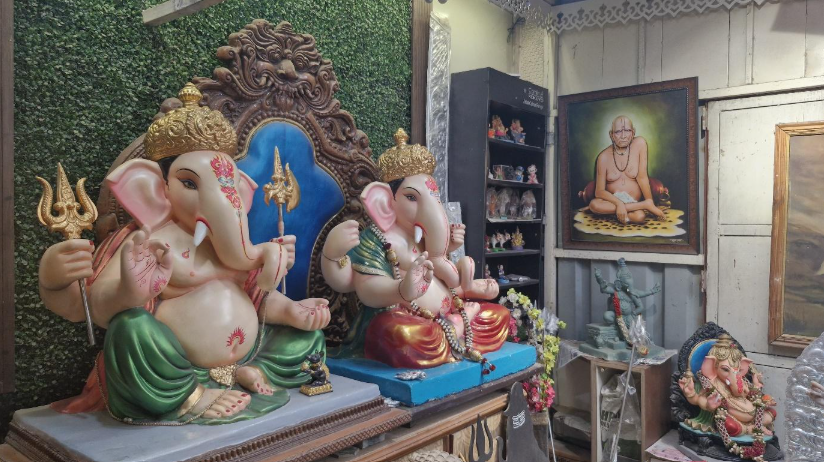
Ganapati idols are the most important part of the Ganesh Chaturthi festival, which is celebrated across Maharashtra and in other parts of India. These idols are made by artists and workers who use their skills, such as painting and sculpting, to complete each idol. Ironically, their work usually goes unnoticed unless it's the festival season. (Image Source: hostedopen.com) ‘Visarjan’, which is the tradition of submerging the Ganesha idols in water after either one-and-a-half, three, five, seven or 11 days since the day of Ganesh Chaturthi, is mainly followed in major cities like Mumbai or Kolhapur for both small and big idols. On the contrary, Pune has a tradition of not submerging the 5 ‘Manache Ganapati’ each year and only submerging the smaller idols. These idols, which are made out of either POP (Plaster of Paris) or other eco-friendly material,s are later submerged under water, but the Manache Ganapati idols are uniquely redesigned every year. “We focus on designing the Ganapati murti (idol) based on the customer's order or demand. We don’t believe in making idols in bulk in factories outside the city and then bringing them to the city during the season. It is important to give time to each step of the process of designing an idol and making sure that we do justice to it while making it,” says Raut about his experience in making Ganapati idols over the past couple of years.
Lokmanya Bal Gangadhar Tilak, a revolutionary during the freedom struggle, and also a resident of Pune, started the ‘Sarvajanik Ganesh Utsav’(All-India Ganesh Festival), a method of public gathering for Indians in a peaceful way while discussing plans for the freedom of India from the British. As far as history dates back, the festival has also been a major way of shaping the city of Pune. Unlike the other cities of Maharashtra, like Mumbai or Kolhapur, etc, Pune celebrates Ganesh Utsav in a more organised and formal manner. The heart of this celebration is the 5 ‘Manache Ganapati’ (or the 5 honoured or revered Ganesha idols) of Pune. These idols are among the earliest and most significant, having been present since the very inception of the festival.
This includes Kasba Ganapati, Tambdi Jogeshwari Ganapati, Guruji Talim Ganapati, Tulsibaug Ganapati and Kesari Wada Ganapati. These are Ganesha idols that are displayed in temples which are mainly run by the temple associations or trusts called ‘Mandals’. Moreover, they are located in different parts of the city (Image 1.1) and are a unique aspect to the processions every year.
Considering the process of designing, sculpting and painting the Ganesha idols that ultimately go into making the Ganesh Utsav a success in Pune, it is important to take note of the idol makers and idol sellers who are solely dependent on these idols as a source of their livelihood. These Murtikars (idol makers or sculptors) are the key to making the festival as lively as it is, since the Ganapati idols are the centre of attraction.
“It feels that God is everywhere around me and we get his blessings when we do this work of designing the idols,” says Nitin, an idol maker and a worker at Rahul Art Studio – a Ganapati Idol making workshop in Guruwar Peth, Pune. Rahul Raut, who is the owner of Rahul Art Studio in the heart of the city, has been involved in designing these Ganapati idols for nearly 20 years and provides employment to four workers for the whole year.
Bhausaheb Rangari Ganapati is considered to be the first Ganapati of India. It was started by a freedom fighter and royal physician named Bhausaheb Rangari, who commenced the first public Ganesha idol installation in 1892. This later gained Tilak’s attention and his appreciation for the same, popularising the practice on a national level. This idol is designed every year by Raut and his team. They begin the work of redesigning and painting the idol nearly two months before the actual festival of Ganesh Chaturthi, and make sure the work is completed smoothly without hindering the worship of the devotees. Nearly 100 different Ganapati mandals and trusts rely upon Raut and his team for the renovation and redesigning of their Ganapati idols year-round.
While speaking to another Ganapati idol seller, Rupali Thakur, who mainly caters to providing Ganapati idols during the major festive season, it was revealed that her factory situated in the Pen region of Maharashtra is where major designs of the idols are completed, and later are brought to the city before the festival (mid-August to early September) for the final touches. “Our orders usually go year-round, and they spike majorly during the season. Although there is demand year-round, and that is why we need workers for the whole year,” says Thakur.
Unlike Raut’s order-specific approach catered specifically for each individual idol, Rupali Thakur uses the bulk-production approach, where workers at her factory produce numerous idols weeks before the festival begins and later sell them depending on the demand.
“I am grateful that I have a job here. Otherwise, it would have been difficult for me to find employment around the year… this is the only work I know. There are some others who are only employed during the season, and they earn less money,” says Nitin, who works at the Rahul Art Studio.
There is no such association to provide the idol makers with opportunities for employment during the year. The reason is that most of these workers either work at independent workshops of their employers or major factories outside the city. Their wages are mainly decided by their employers, who later sell the idols. Since the business model works in a top-down manner, these workers are paid either basic wages (during the season) or a salary (around the year), based on their work per idol. While speaking to Nitin, he revealed that his wages mainly range from Rs. 5,000 to Rs. 8,000 per idol based on the level of work he does.
Lastly, marking a long tradition of Ganesh Chaturthi in the city and highly anticipated ‘Manache Ganapati’ idol designs every year, it is clear that these idol makers are no less than other forces like police and administration when it comes to the true nature of celebrating the festival in Pune.
17 May 2025
Akshat Jain


