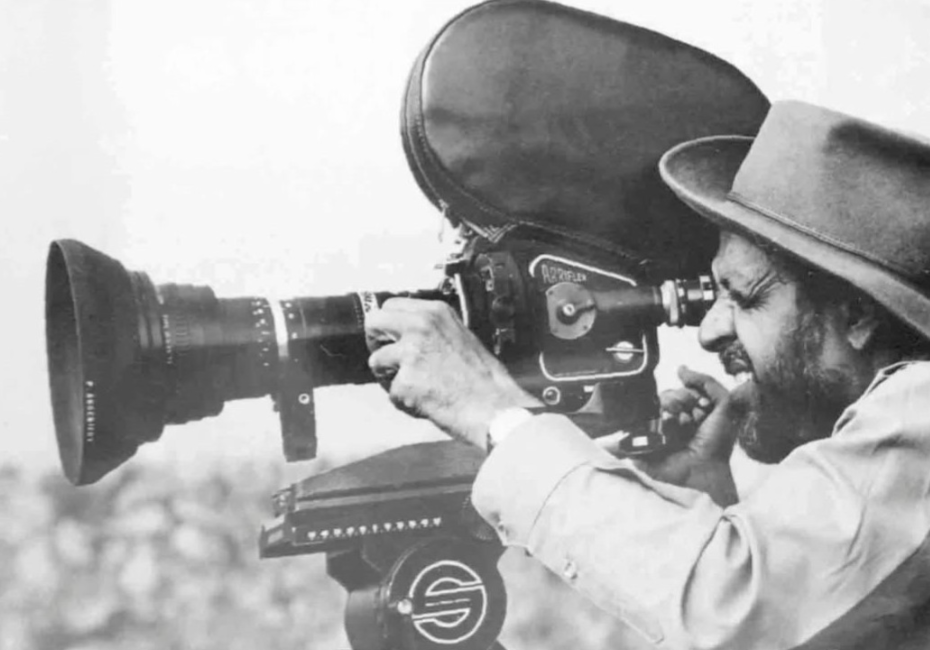
Shyam Benegal, celebrated as the father of the parallel cinema movement, had shaped the course of Indian cinema through his innovative contributions. His pioneering approach to filmmaking brought social realism to the spotlight of Indian Cinema, challenging conventional storytelling and offering audiences a glimpse into the complexities of Indian society. Benegal was born on December 14, 1934, in Hyderabad, State of British India. His father was a professional photographer who owned a small studio. He was also the cousin of the famous Indian actor and director Guru Dutt. Benegal, a passionate advocate of storytelling and filmmaking, created his very own short film at the age of twelve called “Chuttiyon Mein Mauj Maza” with his father's 16mm camera. While studying at Nizam’s College, he read extensively, actively participated in theatre, and served as the college magazine editor. Benegal’s passion for storytelling eventually led him to the Film and Television Institute of India (FTII). Shyam Benegal with a camera. | Image Source: mubi india While Indian cinema was heading towards the “Angry Young Man” era in the 1970s, Benegal released his first directorial debut film, Ankur, in 1974. The film boldly explored various social topics which were generally frowned upon in mainstream Bollywood, including caste, class, and gender issues. It follows Surya, a young man who takes charge of his father’s estate and starts an illicit relationship with Lakshmi, a poor, married woman from a marginalised community. Ankur also marked the acting debut in a major role for the veteran actress Shabana Azami. Other veterans like Naseeruddin Shah, Om Puri and Amrish Puri debuted in Benegal’s films. Ankur was nominated for the Golden Bear, the highest honour for a feature film, at the 24th Berlin International Film Festival. This film also marked an important milestone in the history of Parallel Cinema. Parallel cinema is a film movement that emerged as a contrast to the mainstream, commercial Bollywood movies. By focusing on issues such as poverty, caste discrimination, women’s rights and corruption, this movement sought to present an authentic portrayal of Indian Society. Benegal went on to create a few of the most iconic films in the history of Indian cinema, such as Nishant (1975), Manthan (1976), Bhumika (1977), and Junoon (1979). Manthan, another remarkable masterpiece by Benegal in 1976, is a landmark film in Indian cinema that highlights the empowerment of rural farmers through cooperative movements inspired by Verghese Kurien, who spearheaded the White Revolution in India—funded by more than 500,000 farmers of Gujarat, with each farmer contributing Rs. 2 to the project - making it one of a kind film in the history of Indian cinema. The film's funding model was groundbreaking, showing the unity between the farmers, truly making Manthan a people's film. Manthan, the first crowdfunded film in India, was screened at the 77th Cannes Film Festival in 2024. Benegal fondly recalled his admiration for Former Prime Minister Pandit Jawaharlal Nehru in a recent podcast. He shared how, at a youth festival, he had the chance to meet Nehru and was instantly impressed by Nehru’s remarkable persona. This encounter inspired him to make Bharat Ek Khoj in 1988. It was the television adaptation of the book of the same name by Pandit Nehru. Millions of viewers tuned in each week to watch this show on Doordarshan. This series remains a milestone in the early stages of educational and cultural programming. He also made a feature film on Nehru in 1984 that ran 3 hours long. Titled “Nehru”, it was introduced by former Prime Minister Indira Gandhi. Benegal portrayed women in films through crafted complex, multidimensional female characters. His works like Mandi and Zubeidaa delve deeply into the struggles faced by women in the patriarchal Indian society. Powerful actors like Shabana Azmi and Smita Patil brought authenticity to their characters in his films, creating strong narratives that highlight the struggles and aspirations of women in a patriarchal society. Throughout his career, Benegal’s work was celebrated with various awards. He received the Padma Shri in 1976 and the Padma Bhushan in 1991 for his valuable contributions to Indian art and culture. He was awarded India’s highest award in cinema, the Dadasaheb Phalke Award in 2005. Additionally, he won 19 National Film Awards. Benegal, on 14 December, his 90th birthday, told the Press Trust of India, “We all grow old. I don’t do anything great on my birthday. It may be a special day, but I don’t celebrate it specifically. I cut a cake at the office with my team,” He additionally mentioned that he is working on a few projects, all for the big screen. With his passing, fans worldwide are left wondering how these projects will be carried forward. Beyond his professional accomplishments, Benegal was known for his humility and generosity. His colleagues remember him as a visionary filmmaker who preferred authenticity and creativity over commercial success. Benegal’s passing marks the end of an era in Indian cinema, but his legacy will continue to live on. His memories will be cherished by cinephiles for years to come.
26 Dec 2024
Janak Joshi


