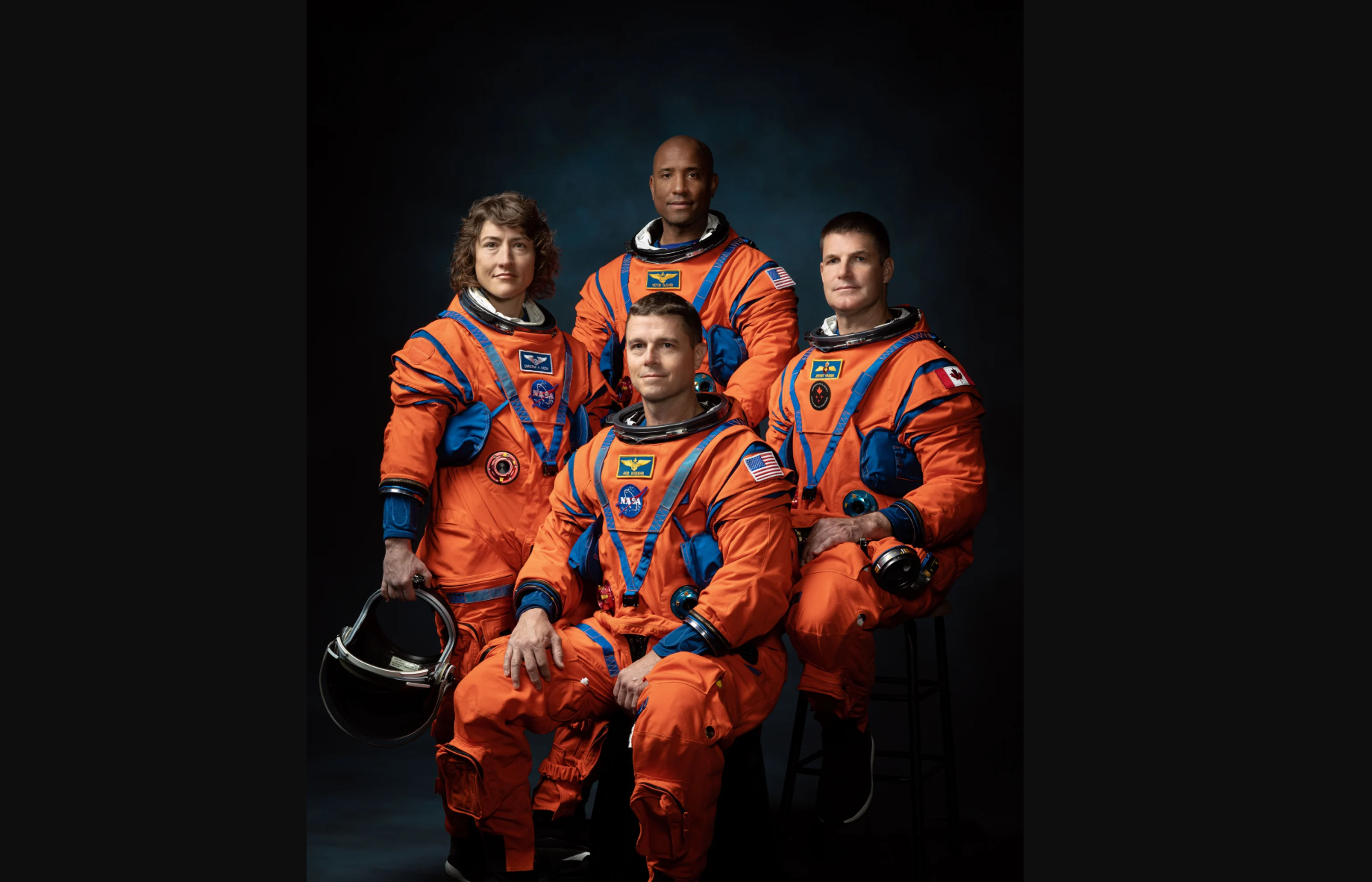
Mission Overview Launched on April 1, 2026 from the Kennedy Space Centre in Merritt Island, Florida after more than 50 years since the Apollo 17 mission, NASA has resumed crewed exploration beyond Earth orbit once again. During this mission, four astronauts have been launched to travel around the moon before returning to Earth. The crew includes NASA astronauts Reid Wiseman, Victor Glover, and Christina Koch, along with Canadian astronaut Jeremy Hansen. The mission is expected to last 10 days, ending with a splashdown in the Pacific Ocean. The mission aims to test critical safety measures required for future deep space exploration. Trajectory and Distance Artemis II is designed to follow a free return trajectory, allowing spaceflight to loop around the moon and return to Earth using lunar gravity. The mission is expected to set several human spaceflight records, including distance from Earth (406,773 km); distance beyond the Moon (about 7,600 km); and velocity (atmospheric re-entry speed of about 40,000 km/h). Mission Objectives and Testing Artemis II is mainly designed to check the Orion Spaceflight, NASA’s deep space crew vehicle, designed to carry astronauts beyond low Earth orbit, and its overall performance in deep space conditions. Key systems, including life support, navigation, propulsion and communication, are being tested to ensure they can operate reliably during long duration missions beyond low Earth orbit. The astronauts are also carrying out operational tasks such as proximity manoeuvres, handling onboard systems and preparing for emergencies. These activities are intended to assess how effectively both the crew and spaceflight can function together in deep space. In parallel with this, the crew is participating in health related experiments, including tracking sleep patterns, studying radiation exposure, and observing how the human body responds in space. The data collected will help scientists to understand the physical and psychological impact of deep space and to improve future deep space missions. Radiation exposure is a key concern. During the mission, astronauts are expected to use about 5% of their total lifetime radiation limit, which is roughly equal to the exposure from spending a month on the International Space Station. Studying these radiation exposure levels will help improve protection systems and establish safety for longer missions, including further lunar landings. Crew Composition The Artemis II crew includes four astronauts, representing both NASA and the Canadian Space Agency. The crew consists of NASA astronauts Reid Wiseman (50), the oldest member of the crew, Victor Glover (49), the first Black astronaut assigned to a lunar mission, and Christina Koch (47), the first woman assigned to a lunar mission. Jeremy Hansen (50) is the first non-U.S. citizen to participate in a mission beyond low Earth orbit. Launch and Early Mission Phases The mission was launched successfully from the Kennedy Space Centre, with the Space Launch System (SLS) generating over 8 million pounds of thrust during liftoff. Post launch, the Orion spaceflight entered a high Earth orbit and later performed a translunar injection burn lasting for approximately six minutes, placing it on a trajectory towards the moon. During the initial phase of the mission, astronauts carried out system checks, tested onboard equipment and prepared for the lunar flyby. The Spaceflight has already travelled more than 100,000 miles from Earth and continues to follow its planned trajectory. Future Prospects Artemis II is part of a broader program focused on returning humans to the moon. The next big mission, Artemis III, is expected to attempt a crewed lunar landing with a focus on the moon's south pole. This region is being studied for the presence of water ice beneath its surface. These resources could be useful for producing fuel and supporting life during future missions. Unlike other missions, Artemis III is designed for long-term exploration rather than short-term visits. Artemis II is set to be the first crewed mission beyond low Earth orbit in over five decades. As astronauts travel in deep space and test critical systems, this mission provides data that will help future lunar exploration. It also reflects a broader step toward expanding human presence beyond Earth, with implications for long-term space missions.
06 Apr 2026
Aman Kawadia


