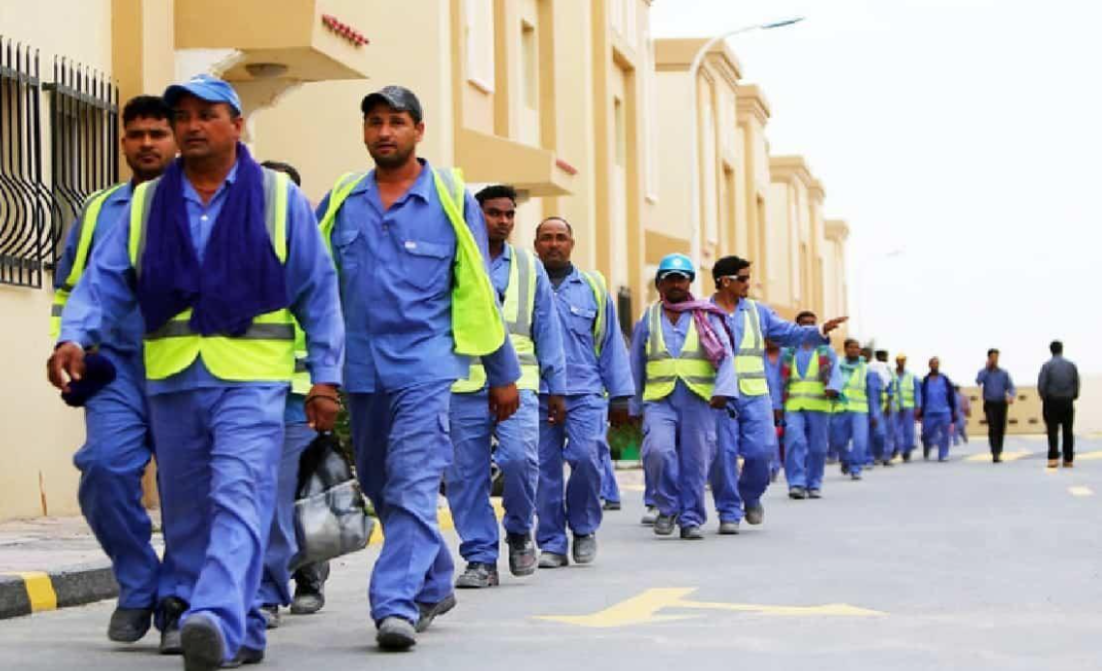
As per the Ministry of External Affairs, more than 92 lakh Indians work in the Gulf Cooperation Council (GCC) nations, 20% of which are in Kuwait and Qatar. Nearly 6000 such workers have died in the past year alone. Many semi-skilled and unskilled workers emigrated for better work opportunities and economic prosperity. The catch is they will work under the Kafala law. The death of 49 workers, 45 of whom were Indians, in the Kuwait fire accident brought the world's attention to their working and living conditions. Crammed into dormitory rooms, with uncertain wages and a lack of legal and social support, the exploitation of these workers is to be blamed on the Kafala system. The Kafala system, a sponsorship-based labour system prevalent in many Middle Eastern countries, has come under increasing scrutiny for its role in human rights abuses. Under this system, foreign workers are tied to their employers, limiting their freedom of movement and making them vulnerable to exploitation. "The kafala law practised in the six GCC countries as well as Jordan and Lebanon is not written anywhere; it is sort of an unwritten law they practice," says Reji K, a senior rights investigator with India and Arab Gul Equidem Research. He further adds, "In this system, the worker is always tied with the workers; it is a form of modern slavery." The kafala came into practice when the GCC discovered oil and needed workers. Chandan Kumar, a Working People's Coalition member, told us that labour rights violations are widespread in the Middle East, ranging from low wages to exploitation of working hours and improper accommodations. "When a worker reaches, their passport is picked up by the contractors, or I would call them traffickers, and then you are nobody," says Chandan Kumar. He adds, "Which means you are working as a paperless illegal immigrant there." Kumar also points to the lack of safety audits happening in the accommodation quarters across the Middle East, which led to the death of many workers living in precarious conditions in Kuwait. The frequency of these incidents is a lot higher than that reported in the international media. "If you read the local papers of the Middle East, hundreds of such incidents happen throughout the year," explains Kumar. Source- Siasat Daily "Limited mobility, employer dominance, language barriers, and fear of retaliation are the primary hurdles," says Sudheer Thirulinath, PRO of Pravasi Legal Cell. "Workers are caught in a web of fear and despair." Pravasi Legal Cell is a non-profit organisation that offers legal advice and Representation in cases involving passport withholding, non-payment of salary, domestic workers' rights, labour disputes, medical issues, and lost passports. Thirulinath expresses his despair about the hurdles that Kafala law creates in their work to help exploited emigrants. He says, "Under the Kafala system, workers' residency and employment are tied to their employers, limiting their ability to change jobs or leave the country without employer consent." He pointed out that despite policy and legal reforms happening in some of the GCC countries, it is difficult for the workers to seek legal assistance, "Even when legal protections exist, enforcement can be inconsistent, and workers may struggle to obtain justice." Labour Laws are mostly conventions under the International Labor Organisation, and the Gulf countries' lack of ratification of these conventions makes them non-binding. Though migrant workers are guaranteed rights under the International Covenant on Civil and Political Rights (ICCPR), the functioning of these laws is cast into doubt. Recent reforms have been made to Saudi Arabia's Kafala system, intended to improve conditions for migrant workers, but they offer limited relief. The new regulations, such as limits on working hours for domestic workers, guarantees of one day off per week, and inclusion in the Wage Protection System, can potentially enhance workers' lives, but only on paper. These reforms fail to address the root of the problem- employer's control over workers' mobility and the legal status surrounding Kafka policies, both remaining largely untouched. The workers remain trapped by restrictive employer practices, including misusing the "huroob" report to claim workers have falsely absconded. In reality, enforcement remains inconsistent and legal protections insufficient, leaving workers vulnerable to ongoing exploitation. While the Kafala law is to be blamed for the exploitative conditions of Indian workers abroad, it is also the government's responsibility to ensure their citizen's human and labour rights are not violated. The Indian government has made provisions like the Pravasi Bharatiya Bima Yojana (PBBY), providing insurance coverage to Indian workers emigrating for employment; online portals like MADAD and E-Migrate are in place, but do they help the workers on the ground facing adverse conditions? "India has signed MoUs and labour agreements with several Gulf countries to protect the rights of Indian workers," says Thirunilath, but the increasing number of exploitation cases and rising deaths of Indian workers question the effectiveness of these deals.
24 Dec 2024
Krishnanshu Panda


